

🎬 Videos(4)

Video
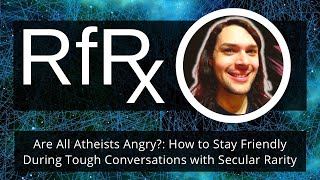
RfRx - Are All Atheists Angry? How to Stay Friendly Through Tough Conversations with Secular Rarity
Recovering from Religion
Tonight we are joined by Secular Rarity! Just a silly guy who enjoys engaging in discussions about religion, science, and philosophy, he has been involved in many different Atheist communities both in front of and behind the camera. He has been a guest on numerous podcasts and is currently a regular host for live shows produced by the Atheist Community of Austin.
📄 Articles(1)
Article
Thank God (and Richard Dawkins) I'm no longer an 'angry atheist'
Alom Shaha
It's all too easy for atheists to imply that people who believe in God are stupid. That's a shame, because fanatical atheism can be as ugly as religious fanaticism
📚 Books(2)
Book
ACT on Life Not on Anger: The New Acceptance and Commitment Therapy Guide to Problem Anger
Georg H. Eifert, Matthew McKay, John P. Forsyth
If you've tried to control problem anger before with little success, this book offers you a fundamentally new approach and new hope. Instead of struggling even harder to manage or eliminate your anger, you can stop anger feelings from determining who you are and how you live your life. Based on a revolutionary psychological approach called acceptance and commitment therapy (ACT), the techniques in ACT on Life Not on Anger can help you let go of anger and start living your life to the fullest.
Book
Lost Faith and Wandering Souls - A Psychology of Disillusionment, Mourning, and the Return of Hope
David Morris
A deeper look at the religious identity crisis of our time that shows a way past our debates and toward a healthier spirituality. Americans are obsessed with religion. You're either in or you're out; you're this or you're that. Except now, so many of us just want to forget the whole thing. We often feel angry, hurt, and alone, while knowing there's a better way. Lost Faith and Wandering Souls helps readers get at these important feelings of disillusionment and shows that the keys to rediscovering hope are within. Religion commentator David Morris puts theological arguments aside and holds up our humanity as equally important. He treats the loss of faith as if it were any other kind of loss, and asks, what if we learned to mourn? He turns to psychoanalytic psychology for its interpretive power. With the concepts of mourning, pining, and play, he shines a light on a path forward. Applying these concepts to contemporary spiritual memoirs, Morris discovers a back-and-forth movement in overcoming faith loss, going between feelings of numbness, self-recrimination, and wandering to playfulness, self-agency, and belonging. If we can feel our loss, he argues, then we can rediscover meaning making. Lost Faith and Wandering Souls acknowledges the religious identity crisis of our time and the full power of the psychological journey. By looking beneath the surface at deep, lifelong dynamics, it shows a way through our losses individually and socially toward a healthier, inclusive spirituality.